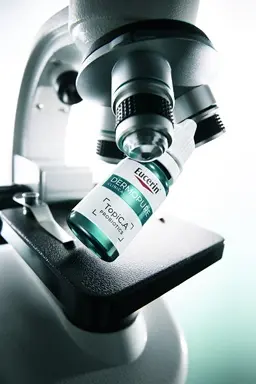
The Science Behind Probiotic Treatment
FOR ACNE-PRONE SKIN
Blemishes have long been treated as a surface problem. But the real story starts much deeper, in the microbiome of the skin. The trillions of microorganisms that make up the skin microbiome play a critical role in keeping skin healthy. When that balance is disrupted, the conditions for blemishes are set in motion – and it starts with one bacterium.
what role does it play?
The skin is home to a vast ecosystem of bacteria, fungi and other microorganisms – the skin microbiome. This microbiota of the skin is as unique as a fingerprint: no two people share exactly the same microbial community.
The most abundant bacterium on the face is Cutibacterium acnes, commonly known as C. acnes. It is a natural and permanent resident of healthy skin. In a healthy skin microbiome, C. acnes bacteria helps support a healthy skin barrier and protects against inflammation. But when its balance becomes disrupted, it can contribute to acne and other skin concerns.


Science has identified six distinct types of the C. acnes bacteria: CA-IA1, CA-IA2, CA-IB, CA-IC, CA-II and CA-III. These six types were identified using advanced phylogenetics technology in the 2000s, built on Beiersdorf's pioneering research dating back to 1894, when Professor Dr. Unna first identified the bacterium.
All six C. acnes types are present in every skin. In healthy skin, they coexist in balance. In acne-prone skin, this balance breaks down: Acne-associated C. acnes begin to overpopulate, while the others are suppressed. This imbalance is a driving cause of blemishes. (Hamann et al. 2025)
CA-IA1 dominates the skin microbiome?
When acne-associated C. acnes dominates the skin microbiome, it triggers a chain reaction:
- Excess sebum production
- Bacterial overgrowth
- Hyperkeratinisation (thickening of the skin that blocks pores)
- Inflammation
- Visible pimples and breakouts

PREBIOTICS, PROBIOTICS AND POSTBIOTICS IN SKINCARE
Microbiome science has identified three types of ingredient that can affect the skin microbiome: prebiotics, postbiotics and probiotics. While prebiotics and postbiotics can support and soothe it, only probiotics can actively restore the C. acnes balance. Here is what each one does:
- Prebiotics
Prebiotics are nutrients that feed the bacteria already present on the skin's surface. Think of them as fertiliser: they help what is already there to thrive. Prebiotic skincare can support the microbiome in general, but because they feed all bacteria they cannot restore a disrupted balance on their own.
- Postbiotics
Postbiotics are beneficial compounds produced by bacteria as by-products – things like short-chain fatty acids and enzymes. Postbiotics in skincare can help soothe and calm the skin, and may support the skin barrier. Like prebiotics, however, they work with what is already on the skin. Postbiotics skincare products cannot replenish bacterial strains that are missing from the microbiome.
- Probiotics
Skin-native probiotics are live, beneficial bacteria. They are the only ingredient category that can actively introduce new bacterial strains to the skin's ecosystem. When applied topically, probiotics can integrate into the existing skin microbiome, helping to replenish beneficial strains and shift the microbial balance back toward a healthier state.
TOPIC.A
The probiotic science behind Probiom8
TopiC.A is the result of over 20 years of microbiome research, 30 scientists and 9 patents pending. It is the world's first skin-native probiotic technology designed specifically for acne-prone skin. CA-31 and CA-81, its two active probiotic strains, were discovered and isolated from healthy human skin – working in harmony with the skin's existing biology and capable of modulating the skin microbiome.
One precise approach.
CA-31 and CA-81 are not identical in their action, and that is by design. Together, they provide a two-speed, complementary approach to C. acnes treatment, targeting the overpopulation of CA-IA1 with both immediate and lasting action.


in one drop
In a single drop, TopiC.A delivers up to 50 million skin-native probiotics to the skin, enough to begin restoring the skin microbiome balance from the very first application. Managing living bacteria in a stable skincare formula was considered nearly impossible. The Eucerin research team made it a reality.
How TopiC.A powers the
PROBIOM8 ROUTINE
TopiC.A is integrated into the Probiom8 8-week routine – a complete skincare system for acne-prone skin, used morning and evening to improve skin microbiome balance. In clinical studies on more than 3,000 patients, the routine delivered a 68% reduction in pimples across 8 signs after 8 weeks.*
* Clinical Study, Brazil 2023, lesion count, reduction of papules, median based on the 33% of subjects with the highest reduction compared to baseline, after 8 weeks